
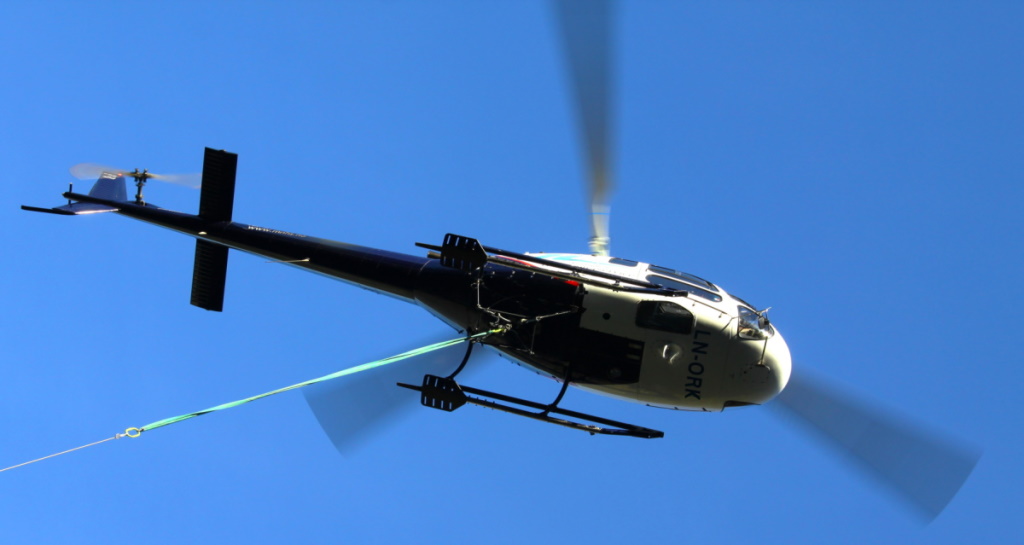
Helicopter cargo lifting — complete guide
Pricing, safety, slinging, landing-site requirements and permits — everything you need before booking a helicopter lift in Norway.
Helicopter cargo lifting is the fastest way to deliver heavy or bulky goods to off-road locations. A light helicopter lifts up to 1,350 kg as suspended load, completes 20–40 rotations per hour, and places materials, concrete or machinery with crane-like precision in minutes.
This guide covers what you need before booking: pricing, permits, slinging, landing-site requirements and on-site procedures. The content is neutral — we compare all 27 Norwegian helicopter operators in our price calculator.
When is helicopter cargo lifting worth it?
A helicopter is the right choice when a road costs more than the flight, the terrain rules out heavy vehicles, or time is short. These are the most common job types:
🏠 Cabin building and renovation
Building materials, insulation, windows, gas and furnishings delivered straight to the cabin site, with no access road.
🏗 Sites in the mountains and rough terrain
Where a road is missing or costs more to build than the flight itself. Common for mountain cabins, holiday homes and ski-lift stations.
⚡ Power lines and pylons
Pylon assembly, conductor stringing and delivery of components to lines in remote terrain — a common job for grid operators.
🧱 Concrete transport
Pumpable concrete in 400-litre aluminium tubs for foundations, pillars and casting — up to 6 m³ per hour.
📦 Big bags and bulk
Sand, gravel, crushed stone, soil or insulation in big bags or cargo nets. Fixed and predictable per rotation.
🚜 Machinery and large components
Construction machinery, prefab elements, tanks and modules to off-road sites — the operator matches the right helicopter to the weight.
📡 Telecom masts and antennas
Delivery and replacement of antennas, dishes and entire mast sections in rough mountain terrain.
🏝 Islands and inaccessible coastline
To places with no quay or road — lighthouses, cabins on islets and power installations along the coast.
What does helicopter cargo lifting cost?
Cargo lifting is billed by the hourly rate. Typical price range in Norway in 2026:
- Light helicopter (AS350 / EC130 / EC120B): NOK 22,000–28,000 per hour
What determines the final price?
- Distance from base to job site — positioning flights are charged at the hourly rate
- Rotation count — more rotations per hour means lower cost per rotation
- Weight and volume per rotation — determines which helicopter is suitable
- Ground crew — supplied by the customer or by the operator (approx. NOK 4,500 per day)
- Refuelling stops — after about 2 h 40 min of flight time (full tank) refuelling is needed. For cargo lifting a fuel truck can be sent to the site (approx. NOK 20 per km round trip)
- Ground time — waiting time between rotations is normally billed. See how flight time and ground time are calculated
- Weather and operating conditions — difficult conditions may incur a surcharge
Minimum billed flight time
The minimum billed flight time is 1 hour. That means short jobs have a fixed floor price — so it pays to combine as many rotations as possible per call-out.
Step by step: how to plan the job
-
Define the scope
Before you contact us you should know: pickup and delivery location (ideally as GPS coordinates from Finn maps or Google Maps), rotation count, type of load, weight per rotation, preferred date and any flexibility. If dangerous goods such as fuel, gas, batteries or explosives are to be carried, this must be notified in advance — it requires IATA handling. Also report any obstacles in and around the area — power lines, cableways, telephone lines, icy patches and other anomalies — so the pilot can plan a safe approach and departure.
-
Obtain permits and authorisations
Ask the landowner for permission to land on cultivated land (innmark), and the municipality for a motorised-traffic permit when landing or lifting in open country (utmark). Apply for a longer window than you think you need — weather and wind can move the day.
-
Compare and book
Use our calculator to see prices from every Norwegian operator based on your exact route, or send an inquiry directly to us. We act on your behalf with the operators and make sure you get the best price in the region — we agree the exact time, meeting point and ground crew for you.
-
Prepare the loading area and the load
Get the load ready the day before: slung and marked, spaced a little apart, with material packs on dunnage so the slings can pass underneath. Secure loose items such as tarpaulins, plastic and big bags — the rotor downwash tears up anything that is not fastened.
-
On the day
Stay reachable by phone all day. Walk the site one last time before the helicopter arrives. Keep cars well away to avoid flying stones. Dogs on leads, drones on the ground. Once the crew is in place, follow their instructions to the letter.
Permits and authorisations — municipality and landowner
In Norway, motorised traffic in open country is generally prohibited under the Motor Traffic Act (motorferdselloven). That means landing and cargo lifting outside designated landing sites require a permit from the municipality, and permission from the landowner where you actually land or unload.
Cultivated land vs. open country
Cultivated land (innmark) (farm, tilled fields, near buildings): only the landowner’s permission is required. Open country (utmark) (mountains, grazing land, uncultivated forest): both a municipal permit and the landowner’s permission.
How to apply
- Apply in good time — processing often takes 2–4 weeks
- Ask for a few more trips than you think you need — for weather contingency
- Ask for a generous time window (e.g. 2 weeks, not a single day) — for flexibility
- Provide GPS coordinates for the landing point and delivery site
- Use the municipality’s digital application form if one exists
Requirements for the landing and loading area
A helicopter needs a large safety margin around it — during landing, boarding and the lifting operation alike. The pilot makes the final call on whether the site is safe, but these minimum requirements make it practically feasible:
- Minimum 20-metre diameter, flat and clear of loose objects
- A surface that withstands rotor downwash — grass, firm snow, gravel or rock. Not loose sand, sawdust or plastic
- Slope no more than 5–8° — otherwise you risk dynamic rollover
- Clear approach and departure path — no power lines, cableways, treetops or buildings within a 30° cone rising from the site
- Never approach over buildings or people during cargo lifting — the pilot chooses a path over open ground
- Obstacles must be reported — power lines, guy wires, telephone lines, icy patches and other anomalies
- Keep parked cars away — at least 30 metres to avoid flying stones and paint damage
Safety around the helicopter
Helicopters are safe machines — as long as you understand the zones around them and follow the ground crew’s instructions. Two things kill: the main rotor at the front and the tail rotor at the back. Both are almost invisible when spinning.
Safety zones — seen from above
🟢 Green — safe access. The front and forward sides within the pilot’s field of view. Always approach the helicopter at an angle from the front, never straight from behind.
🟡 Yellow — caution. The sides beneath the main rotor. Stay low, keep heavy objects horizontal, and do not raise arms or poles above your head.
🔴 Red — forbidden. The entire rear half. The tail rotor is small, spins at over 2,000 rpm and is practically invisible. Never walk behind.
When the helicopter is on site
- Stay calm — do not rush or run
- Stay within the pilot’s and ground crew’s field of view
- Follow the crew’s instructions — they are in charge
- Wear a helmet, ear protection and safety boots if you work around the rotations
- Seatbelt and ear protection on when seated in the helicopter
What NOT to do
- Never move behind the helicopter
- Never stand on ground higher than the helicopter
- Never take selfies during a rotation
- Do not let dogs loose — they panic in the rotor downwash
- Do not fly a drone nearby — risk of collision
- Do not leave tarpaulins, plastic or loose big bags — the downwash carries them off
Slinging the load — how to prepare the rotations
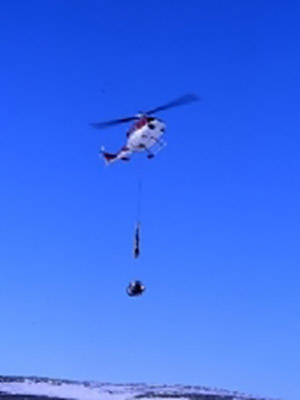
The operator always provides approved lifting slings, shackles, rings and cargo nets, and a ground crew member who takes responsibility for the slinging. Even so, there is a lot to gain from organising the load well before the helicopter arrives — you save both time and money.
The main principle: diagonal suspension, blunt end forward, the load stabilised against rotation. Here are the most common load types and how they are slung:
Materials in a bundle
Even height and width, blunt end forward. Diagonal slings prevent rotation. Dunnage underneath for clearance.
Windows and doors
Flat on a Euro pallet, four-point slinging. Never mix window sizes in the same rotation.
Roof trusses
Diagonal slinging is critical to avoid twisting. Mark the first and last for orientation.
Roofing sheets
On a pallet between two timber frames running the full length. Diagonal slinging to prevent bending.
Big bag
Orange, slung from all four lifting loops. For sand, gravel, crushed stone, insulation and bulk.
Concrete tub
400 L aluminium, used in pairs. 5–6 m³ per hour for foundations and pillars.
Cargo net
For insulation and small packages. Gathers many small units into a single rotation.
Roof tiles and blocks
Heavy cardboard or shrink wrap on a pallet. Prevents flying stones from the rotor downwash.
Materials (planks, beams, bars)
Sling in a bundle of as even a height and width as possible, with one blunt end — it counteracts rotation in the air. Packs are placed on dunnage (10–15 cm clearance) so the slings can pass underneath. The slings are fixed diagonally, not in parallel.
Windows and doors
Laid flat on a pallet, but do not mix sizes in the same rotation — risk of slippage. Lashed with tight slings, ideally with a tarpaulin over them for weather.
Roofing felt and rolled materials
The rolls are placed on a pallet, or in a cargo net if they are compact and of the same size. Remember to secure them against unrolling in transit.
Roofing sheets and corrugated panels
On a pallet, between two frames running the full length of the sheet. Diagonal slinging. Thin sheets need frame clamps at both ends, otherwise they bend under their own weight.
Roof trusses
Slung in suitable rotations according to weight and size. Diagonal slinging is critical to avoid twisting the structure. It helps to mark the first and last truss so the ground crew can see the orientation.
Roof tiles, bricks and building blocks
On a pallet, well wrapped in heavy cardboard or shrink wrap. Stone products are vulnerable to rotor downwash — loose pieces blow out and become projectiles.
Sand, gravel and crushed stone
Big bag or an aluminium tub. The big bags must be orange (for visibility) and slung from all the lifting loops. The tubs are more expensive but faster to fill and empty — common on concrete projects.
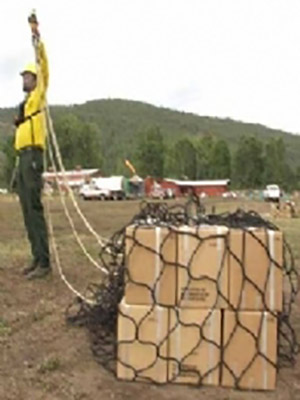
Machinery and large components
Slung directly from the attachment points if the machine has them (most construction machines do). Large machines are often split into smaller units to fit within the lift capacity — the pump separately, the engine separately, and so on.
Concrete in tubs
400-litre aluminium tubs are used in pairs to make concrete transport efficient: one tub on the way up, one being emptied on the ground. A light helicopter manages 5–6 m³ per hour with this set-up.
Returning the slings
After the final rotation the slings must be returned to the loading area to be collected. The ground crew bundles them so they do not tangle — a common technique is to fold the sling in quarters, tie a slip knot and pass the ring through the loop.
Hand signals — how the helicopter is directed over the load
With the engine running and the rotor spinning, the pilot hears nothing from the ground. Hand signals are the language. The ground crew stands in front of the helicopter, within the pilot’s field of view, and signals what is happening:
Lift
Right arm straight up, circular movements with the index finger. “Sling taut — you can take up”.
Hold altitude
Both arms straight out to the sides, horizontal. “Stay where you are”.
Fine-tune
The ground crew grabs the load and nudges the last little bit into place by hand.
Lower
Right arm in circular movements downward, until the load rests on the ground and the sling is slack.
Position
Both arms extended forward, moved repeatedly from horizontal to down toward the ground — “set it down where I point”.
Release
Right forearm swept side to side horizontally — “the load is in place, you can release the sling”.
Helicopter types and lift capacity
The right helicopter for the right job — the lift capacity determines which operator is relevant for your project:
Eurocopter AS350 B3 (Light)
EC120B (Light)
EC130 (Light, 6–7 seats)
See all helicopters in Norway for specifications per operator. When you book, the operator matches the right machine to the job — standard cabin transport works perfectly with the AS350, while the EC120B and EC130 also cover passenger transport.
Transport terms — what is typically included?
Norwegian helicopter operators largely follow the same industry standard for cargo jobs. A typical quote includes:
- A suitable helicopter with a pilot and ground crew
- Fuel that the machine can carry on board
- A standard 18 m longline for safe and efficient operation
- Lifting equipment: slings, shackles, rings, cargo nets
- Insurance pursuant to sections 10 and 11 of the Aviation Act (Luftfartsloven)
Additional costs (on top of the hourly rate)
- Positioning flights to/from the job site — charged at the agreed hourly rate
- Ground time — idle time during preparation or waiting
- Per diem and accommodation — at government rates for jobs requiring an overnight stay
- Administrative costs — a fee per job
- Transport of fuel and special equipment beyond what the helicopter can carry on board
- Landing fees when using certified airfields en route
- Special equipment — Bambi bucket (firefighting), concrete tub, cable layer, etc.
Insurance and liability
Insurance of cargo and equipment is limited to 19 XDR per kg (XDR = the IMF’s Special Drawing Rights, approx. NOK 14 in 2026). Valuable equipment and materials should be additionally insured by the customer — the operator can often arrange this for a surcharge.
Cancellation
Cancellation must normally be made no later than the day before the scheduled date. Otherwise the minimum billed flight time is charged. Postponement due to weather is normally accepted without cost if notice is given before the helicopter leaves base.
Note: these are the cancellation terms for cargo lifting. For VIP transfers and taxi flights separate cancellation terms apply — contact us for details.
Dangerous goods
Petrol, diesel, gas, explosives, batteries and weapons are classified as dangerous goods and are carried under IATA regulations. Notify the operator in good time — it requires special packaging and documentation.
Frequently asked questions about cargo lifting
What does helicopter cargo lifting cost?
Cargo lifting is billed by the hourly rate. The typical range is NOK 22,000–28,000 per hour for a light helicopter (AS350 class). The total price is driven by distance from base, rotation count, weight per rotation and whether ground crew is supplied by the operator. Use our calculator for estimates from every Norwegian operator.
How much can a helicopter lift?
A light helicopter (Eurocopter AS350) lifts 900–1,350 kg as a suspended load. The EC130 is comparable, while the EC120B is intended for lighter loads and passenger transport. The weight depends on temperature, elevation and fuel quantity — hot days and high mountains reduce the capacity.
Do I need a permit to land a helicopter?
For landing on cultivated land (innmark) you need the landowner’s permission. For landing or cargo lifting in open country (utmark) you must apply to the municipality for a motorised-traffic permit under the Motor Traffic Act (motorferdselloven). Apply in good time and ask for a few extra trips for flexibility in case of weather. Protected areas also require a dispensation from the County Governor (Statsforvalteren).
How large must the landing site be?
A minimum of 20 metres in diameter, flat and clear of loose objects. No buildings, power lines, cableways or treetops in the approach or departure path. The slope should not exceed 5–8 degrees.
Who slings the load?
The operator always provides a ground crew member responsible for slinging and safe hook-up. You can also provide your own ground crew for a reduction in the price — the usual rate is NOK 4,500 per day for a ground crew member from the operator.
Can a helicopter fly in rain and wind?
Light rain and wind up to about 20 m/s are normally not an obstacle. Cargo lifting is halted in heavy precipitation, visibility below 1,500 m, or gusts over 25 m/s. The pilot makes the final decision, and jobs are postponed at no cost when a weather hold is notified before departure from base.
What is the minimum billed flight time?
The minimum billed flight time is 1 hour. Positioning flights from base to the job site and back are also charged.
How far from the helicopter must I stand?
A minimum of 20 metres during start-up and departure. Never move behind the helicopter — the tail rotor is deadly and almost invisible. Always follow the ground crew’s instructions and stay within the pilot’s field of view.
Can I share a helicopter with neighbours for a lower price?
Yes — this is called co-flying, and it is the most effective way to reduce the price. When several jobs in the same area are combined into a single call-out, the call-out cost is shared. Typically save 30–50% compared with a single job.
What about dangerous goods such as fuel and gas?
Petrol, diesel, propane, batteries and explosives are dangerous goods and are carried under IATA regulations. Notify the operator in advance — it requires special packaging and documentation.
Further reading — related topics
Packing and slinging guide
Detailed guidance on how different materials should be slung for safe helicopter transport — aimed at cabin builders and contractors.
Co-flying of helicopter jobs
How to halve the price by sharing the call-out with neighbours or nearby building sites.
Big-bag transport of loose material
The big bag is the efficient way to transport sand, gravel, crushed stone and bulk material by helicopter.
Concrete transport by helicopter
Pumpable concrete in aluminium tubs — up to 6 m³ per hour to sites with no road access.
Cabin transport by helicopter
Focused on transport to cabins — from the first site survey of the loading area to the final rotation.
The helicopters in Norway
An overview of which helicopter types are available and which jobs they suit.
Prices and billing terms
Detailed price information, minimum prices, surcharges and payment terms for helicopter jobs.
Price calculator for cargo lifting
Calculate the cost of your specific job — compare 27 Norwegian operators in seconds.
This guide was last updated in May 2026. The content is neutral and covers industry standards for Norwegian helicopter operators.